
The Truth About Props (And Why Grabbing a Block Isn't Cheating)
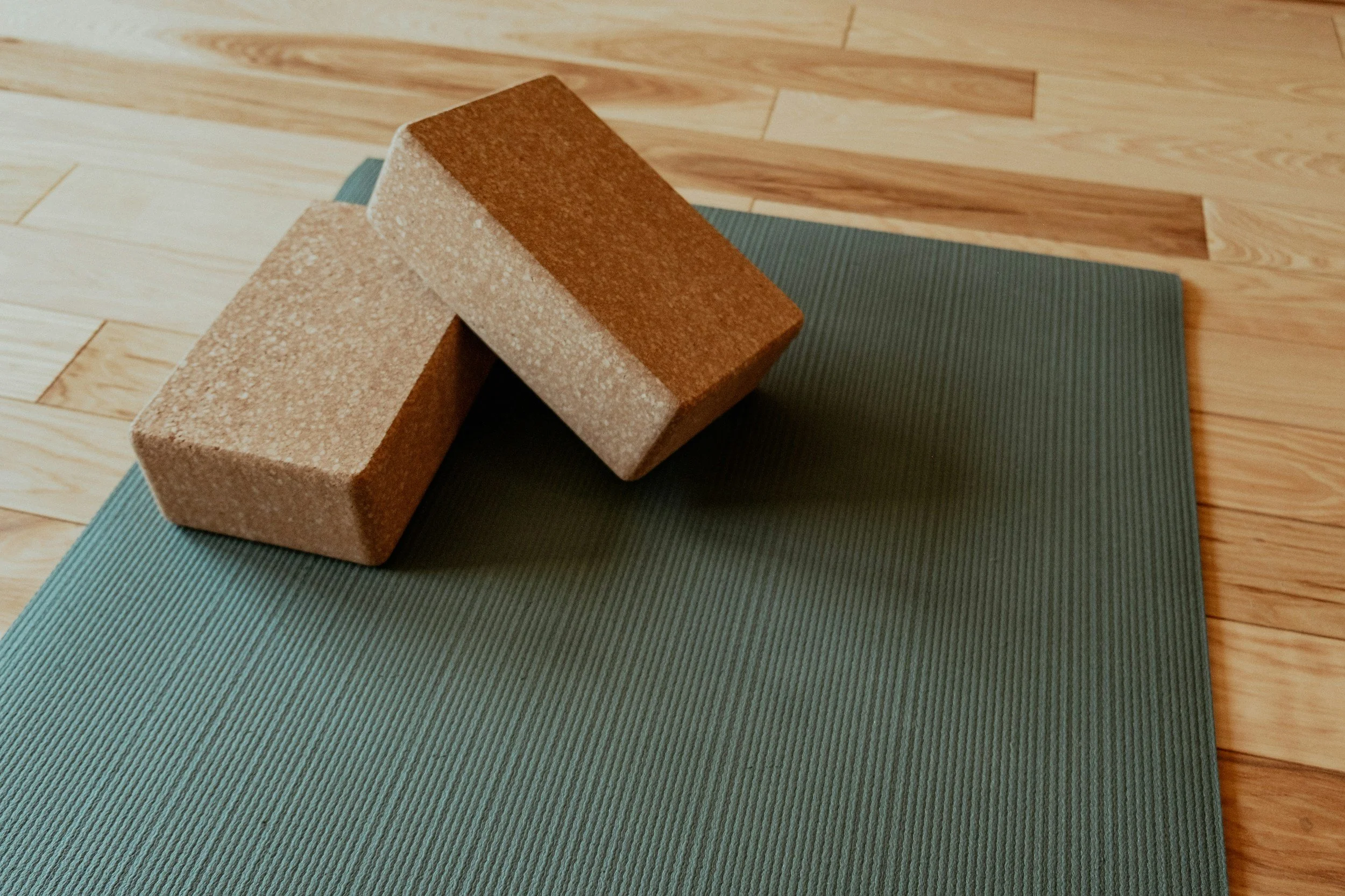
There’s a specific kind of hesitation that happens right before a new student reaches for a block. You can almost see the thought cross their face: if I need this, I must be doing it wrong. So the hand pulls back, the reach doesn’t happen, and they spend the next few minutes straining toward the floor instead, jaw tight, breath shallow, waiting for the pose to end.
We see it every week, and it’s worth saying plainly: needing a prop is not a sign of failure. It’s not the beginner version of the pose. It’s not something you graduate out of once you’re “good enough.” A block, a strap, a bolster, even the wall, these are tools that let your body find the actual shape and benefit of a pose instead of a strained approximation of it.
Here’s where the misunderstanding comes from. Most people’s first exposure to yoga is a photo or a video of someone folded impossibly deep into a posture, hands flat on the floor, forehead to shin. That image becomes the unspoken standard. Anything short of it feels like a lesser version, and reaching for help feels like admitting you couldn’t hit the standard on your own. But that photo was never the point of the pose to begin with. A forward fold isn’t about touching the floor. It’s about lengthening the spine and releasing the back body, and a block under your hands can get you there with better alignment than jamming your palms flat ever would.
Think about it from the other direction. A prop doesn’t make a pose easier in the sense of doing less work. It makes the pose accurate. Without a block, someone with tighter hamstrings rounds their spine to force their hands down, which shifts the work away from where it’s supposed to happen and into the lower back instead. With the block, the spine can stay long, the hips can hinge properly, and the muscles that are actually meant to lengthen get to lengthen. That’s not a shortcut. That’s the pose working correctly for the body in the room, which is always going to be different from the body in the photo.
Experienced practitioners use props constantly, for exactly this reason, though you might not notice it if you’re new. A teacher reaching for a block in a pose she’s held for twenty years isn’t demonstrating a fallback. She’s demonstrating that the prop was never about ability level in the first place. It’s about giving a joint or a muscle group the support it needs to do its actual job, which changes day to day even for the same person. Tight hips on a Monday might call for a block under the knee in a seated pose. Loose hips on a Thursday might not need it at all. Neither day is the “real” practice. They’re both just accurate responses to what the body brought that day.
There’s also a quieter benefit to reaching for a prop that has nothing to do with the pose itself. It’s a small, repeatable act of listening to your body instead of overriding it, and that habit tends to travel with people off the mat. Students who get comfortable saying “I need a modification here” in a yoga class often get more comfortable saying “I need a break” or “that doesn’t work for me” in other parts of life too. The prop isn’t just support for a hamstring. It’s practice at taking your own limits seriously instead of pushing through them to look a certain way.
If you’ve been avoiding the props shelf because it felt like an admission, we’d genuinely like you to stop. Every mat space at Emerald has blocks and a strap within arm’s reach for exactly this reason, and every teacher would rather see you use them early than watch you brace through a pose that isn’t landing right for your body. This goes for every class we teach, from a slower Restorative session to a heated Power Vinyasa flow. Reaching for a block in the middle of a hard class isn’t backing off. It’s making sure the effort you’re putting in actually goes somewhere useful.
And if you’re not sure when to use one, ask. That’s a completely normal question, and it usually takes about ten seconds to answer. Come try it out, props and all. Nobody in the room is going to think less of you for it, and after a few classes, you probably won’t think twice about it either.