
Tarot Is a Tool for Reflection, Not a Crystal Ball
Most people approach tarot carrying a set of assumptions: someone across a table turning cards face-up one by one, delivering news about what is coming. That image is vivid enough that it keeps a lot of curious people from ever actually picking up a deck. But that is not what most people who use tarot are doing with it.
Tarot is better understood as a structured tool for self-reflection. The deck holds 78 cards, each carrying an image and a set of symbolic associations that have been interpreted and built upon over centuries. When you pull a card, you are not receiving a verdict about the future. You are receiving a prompt — something to sit with, something to look at from more than one direction. The question is not "what will happen" but "what is worth paying attention to right now."
That framing tends to make a lot more sense to people who practice yoga. The same quality of honest, present-moment attention that yoga asks of you on the mat is exactly what tarot asks of you at the table.
The deck breaks into two sections. The first is the Major Arcana, 22 cards that each represent a larger archetype or universal life theme. The Fool represents the energy of new beginnings and the willingness to step into the unknown. The Tower signals sudden disruption and the breaking apart of structures that were no longer serving. The Star carries themes of hope, healing, and quiet renewal after difficulty. Justice deals with accountability, cause and effect, and the need for clarity. These are not predictions. They are mirrors. When a Major Arcana card comes up in a reading, it tends to indicate something significant is worth examining.
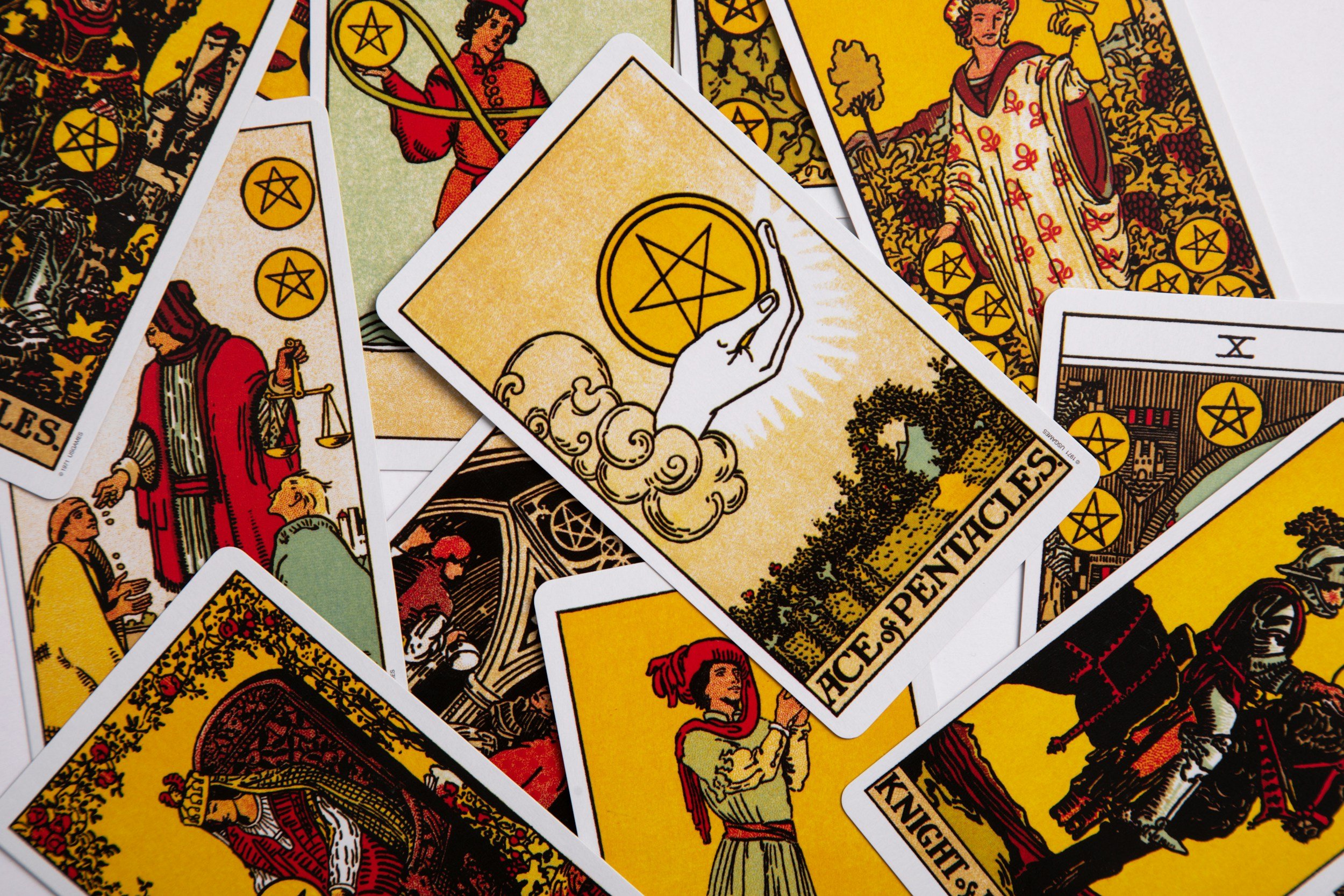
The second section is the Minor Arcana, 56 cards divided into four suits, each one associated with a different area of human experience. Wands carry the energy of passion, motivation, and creative drive. They often show up around questions of purpose, ambition, and what you are building. Cups deal with the emotional and relational — love, grief, connection, intuition, the inner life. Pentacles are the practical suit: money, work, physical health, the material world and what we are investing our energy into. Swords move through the domain of thought, communication, and conflict. They are the cards of difficult truths, mental clarity, and the choices that require courage to make.
Within each suit are 14 cards: numbered cards from Ace through Ten, and then four court cards. The Page, Knight, Queen, and King each represent a different level of experience within that suit's territory. A Page of Wands is just beginning to discover their creative drive. A Queen of Wands has developed a mature and confident relationship with it. Learning to read the difference between court cards adds a layer of specificity to a reading that goes beyond general themes.
Reading with tarot is a learnable skill, and it develops the same way most skills do: through repetition, reflection, and a willingness to sit with uncertainty rather than rush to certainty. Most beginners start with a single-card pull. You hold a question, shuffle the deck, draw one card, and then work with it. What does the image bring to mind? What does it have to do with what you asked? Where do you feel resistance to what it is suggesting? The interpretation is never fixed. It is a conversation between the card and the person holding the question.
From there, readers begin to work with spreads, multi-card arrangements where each position in the spread represents something specific. A three-card spread might place one card for the past, one for the present, and one for the direction things are moving. A Celtic Cross spread uses ten cards to look at a situation from multiple angles. The structure of a spread gives a reading shape and context, which makes the individual cards easier to interpret in relation to one another.
Learning all of this on your own is possible, but it is slow. The symbolism is dense, the variations between decks are significant, and without someone to practice with, it can feel like studying a language with no one to speak it to. That is exactly what this workshop is designed to address.
On Friday, October 30th from 6:00 to 8:00pm, Emerald Yoga Studio is hosting an Intro to Tarot Card Reading workshop with Amanda of Mystical Dabbling Tarot. Amanda built this workshop specifically for beginners, and the structure reflects it. You will start with the foundations: what tarot is, how the deck is organized, what each suit represents, and how to read the court cards. From there, the workshop moves into practice — shuffling, pulling cards, and then pairing up with a partner to read for one another. Reading for another person, even as a beginner, is one of the fastest ways to build confidence with the cards. If time allows, the workshop closes with journaling and group discussion.
Bring a notebook. Bring a deck if you have one. Decks will also be available for purchase at the studio.
Space is limited intentionally, so the workshop stays hands-on and personal rather than lecture-style. Pre-registration is required. The cost is $35 for members and $40 for non-members.
If you have been curious about tarot and waiting for a good place to start, this is it. Register at emeraldyoga.com/events.